Denoise node positions
A coordinate diffusion model samples spatial locations for graph vertices in 3D.
MICCAI 2024
3D Vessel Graph Generation Using Denoising Diffusion
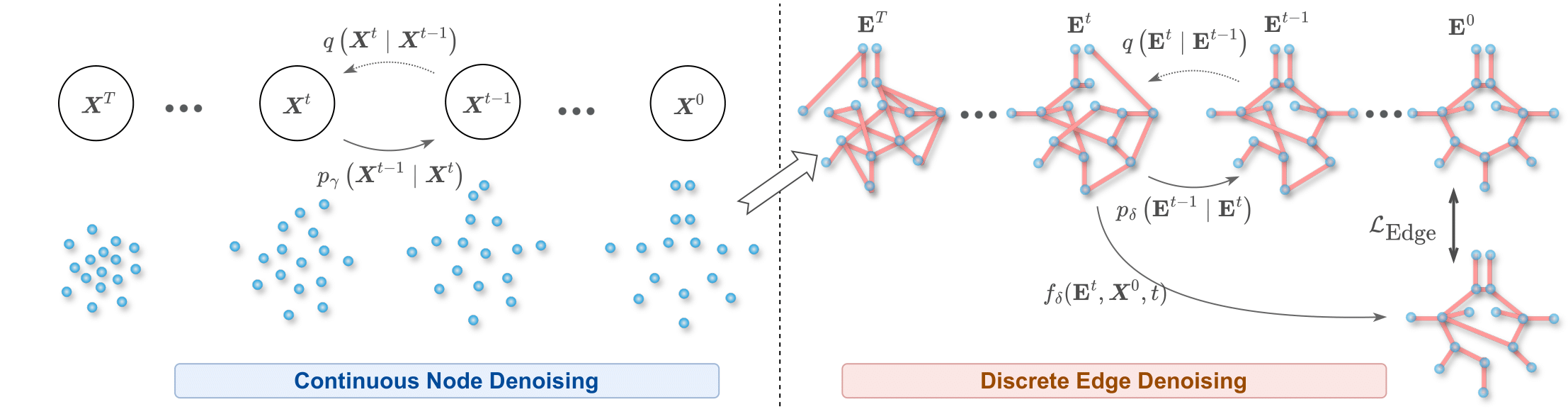
Two-stage diffusion pipeline, from the official code repository. · Original figure ↗
Overview
Many existing graph generators focus on tree-like structures, yet real vascular networks may contain cycles. This work introduces a two-stage denoising diffusion approach that first generates 3D node coordinates and then samples edge connectivity to build diverse, anatomically plausible vessel graphs.
Approach
A coordinate diffusion model samples spatial locations for graph vertices in 3D.
A subsequent discrete diffusion model predicts graph edges while keeping the generated node coordinates fixed.
Compare generated vessel networks with real-world vascular graphs, including their geometry and connectivity.
Research directions
Model vascular networks in which cycles are a natural topological feature.
Generate major-vessel structures including the Circle of Willis.
Study diverse, previously unseen vessel graph samples and their structural statistics.
Results
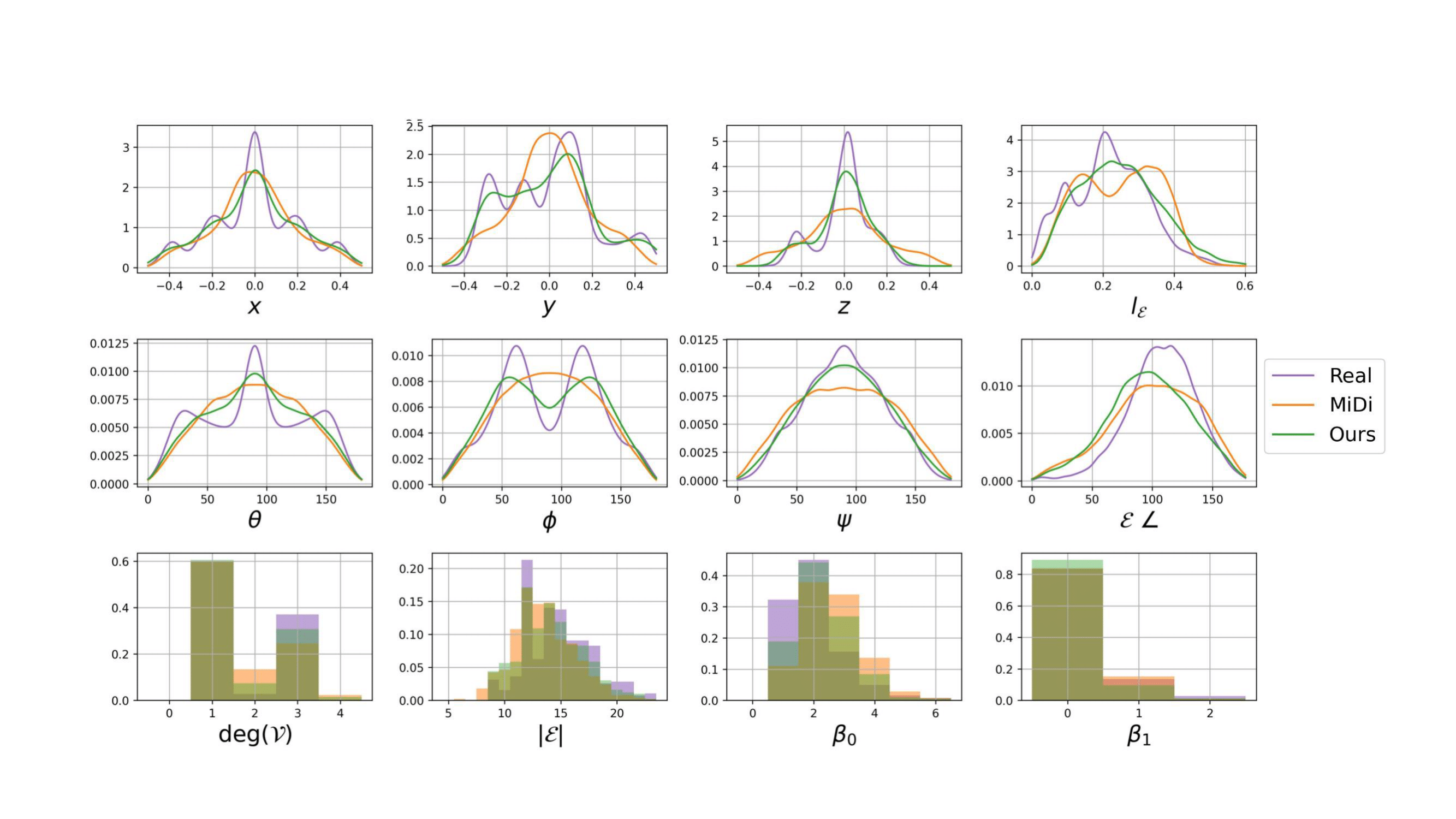
Graph-property comparisons from the official repository. · Original image ↗
Resources
The official repository contains code for coordinate and edge diffusion, instructions for preparing the vascular datasets, and tools for graph visualization and statistical comparison.
Reference
@inproceedings{prabhakar2024vesseldiffusion,
  title = {3D Vessel Graph Generation Using Denoising Diffusion},
  author = {Prabhakar, Chinmay and Shit, Suprosanna and Musio, Fabio and Yang, Kaiyuan and Amiranashvili, Tamaz and Paetzold, Johannes C. and Li, Hongwei Bran and Menze, Bjoern},
  booktitle = {Medical Image Computing and Computer Assisted Intervention -- MICCAI 2024},
  pages = {3--13},
  year = {2024},
  publisher = {Springer},
  doi = {10.1007/978-3-031-72120-5_1}
}